Trudi Case

Taming the ketamine tiger: a revolutionary treatment could patients...
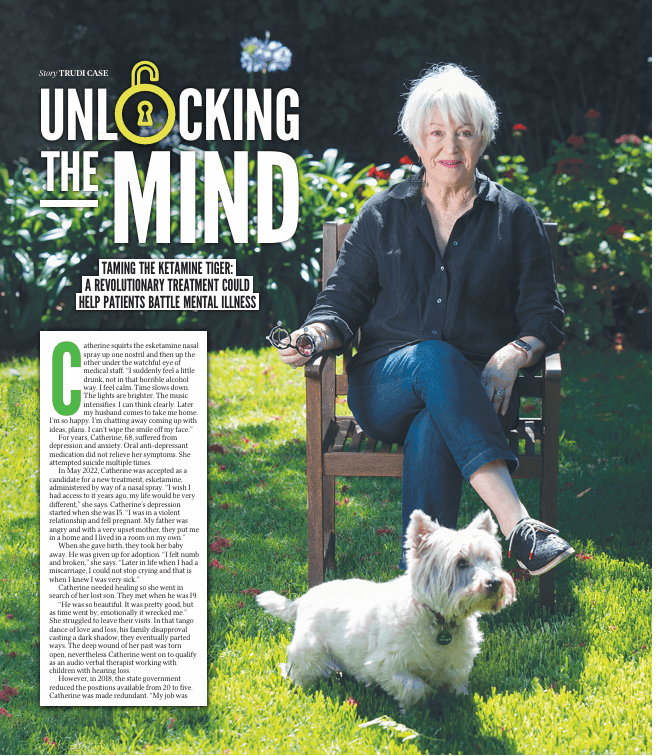
Catherine squirts the esketamine nasal spray up one nostril and then up the other under the watchful eye of medical staff.
“I suddenly feel a little drunk, not in that horrible alcohol way. I feel calm. Time slows down. The lights are brighter. The music intensifies. I can think clearly. Later my husband comes to take me home. I’m so happy. I’m chatting away coming up with ideas, plans. I can’t wipe the smile off my face.”
For years, Catherine, 68, suffered from depression and anxiety. Oral anti-depressant medication did not relieve her symptoms. She attempted suicide multiple times. In May 2022, Catherine was accepted as a candidate for a new treatment, esketamine, administered by way of a nasal spray. “I wish I had access to it years ago, my life would be very different,” she says.
Catherine’s depression started when she was 15. “I was in a violent relationship and fell pregnant. My father was angry and with a very upset mother, they put me in a home and I lived in a room on my own.” When she gave birth, they took her baby away. He was given up for adoption. “I felt numb and broken,” she says. “Later in life when I had a miscarriage, I could not stop crying and that is when I knew I was very sick.”
Catherine needed healing so she went in search of her lost son. They met when he was 19. “He was so beautiful. It was pretty good, but as time went by, emotionally it wrecked me.” She struggled to leave their visits. In that tango dance of love and loss, his family disapproval casting a dark shadow, they eventually parted ways. The deep wound of her past was torn open, nevertheless
Catherine went on to qualify as an audio verbal therapist working with children with hearing loss.
However, in 2018, the state government reduced the positions available from 20 to five. Catherine was made redundant. “My job was me, my success, my skills.” She overdosed on pills, was admitted to the Adelaide Clinic and, when settled on medication, allowed to go home. But the deep, dark well of sorrow crippled her. “I had painted all my life. I couldn’t do it anymore. I couldn’t socialise. I would just stay in bed,” she says.
Many others suffering mental illness also end up in a dark place. Suicide Prevention Australia reported that 3249 Australians died by suicide in 2022. Males are around three times more likely to die by suicide than females.
Enter ketamine, a drug introduced in the ’60s as an anaesthetic, but also used illegally as a recreational “party drug”. If snorted, the effects of ketamine are felt quickly, bringing about a sense of euphoria and wellbeing, though not without troubling side effects including hallucinations and dissociation. It’s also a drug of dependence and easily abused.
Ketamine has two mirror-image molecules: R-ketamine and S-ketamine. Esketamine is the S molecule of ketamine and is up to four times more potent as an anaesthetic. For depression, both esketamine and ketamine have been found to be highly effective treatments.
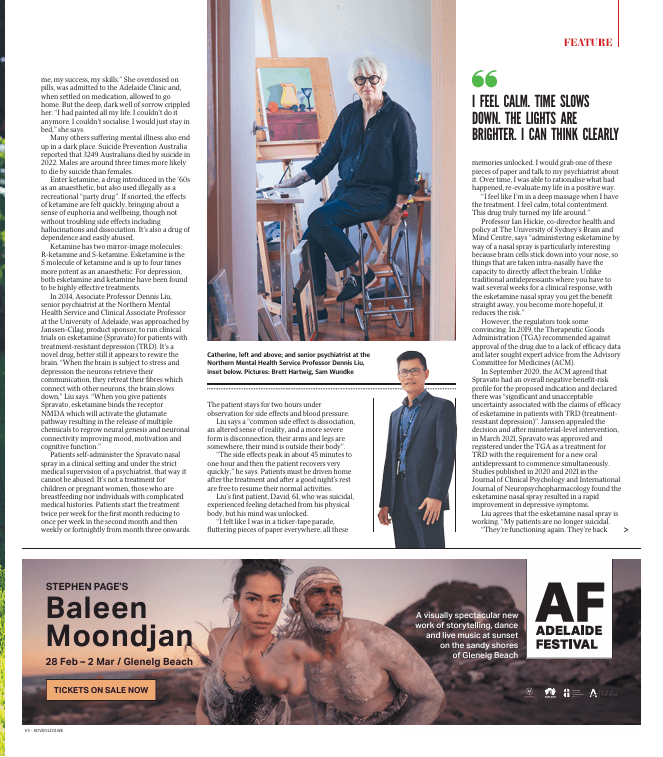
In 2014, Associate Professor Dennis Liu, senior psychiatrist at the Northern Mental Health Service and Clinical Associate Professor at the University of Adelaide, was approached by Janssen-Cilag, product sponsor, to run clinical trials on esketamine (Spravato) for patients with treatment-resistant depression (TRD). It’s a novel drug, better still it appears to rewire the brain. “When the brain is subject to stress and depression the neurons retrieve their communication, they retreat their fibres which connect with other neurons, the brain slows down,” Liu says. “When you give patients Spravato, esketamine binds the receptor NMDA which will activate the glutamate pathway resulting in the release of multiple chemicals to regrow neural genesis and neuronal connectivity improving mood, motivation and cognitive function.”
Patients self-administer the Spravato nasal spray in a clinical setting and under the strict medical supervision of a psychiatrist, that way it cannot be abused. It’s not a treatment for children or pregnant women, those who are breastfeeding nor individuals with complicated medical histories. Patients start the treatment twice per week for the first month reducing to once per week in the second month and then weekly or fortnightly from month three onwards.
The patient stays for two hours under observation for side effects and blood pressure. Liu says a “common side effect is dissociation, an altered sense of reality, and a more severe form is disconnection, their arms and legs are somewhere, their mind is outside their body”. “The side effects peak in about 45 minutes to one hour and then the patient recovers very quickly,” he says. Patients must be driven home after the treatment and after a good night’s rest are free to resume their normal activities. Liu’s first patient, David, 61, who was suicidal, experienced feeling detached from his physical body, but his mind was unlocked.
“I felt like I was in a ticker-tape parade, fluttering pieces of paper everywhere, all these memories unlocked. I would grab one of these pieces of paper and talk to my psychiatrist about it. Over time, I was able to rationalise what had happened, re-evaluate my life in a positive way.
“I feel like I’m in a deep massage when I have the treatment. I feel calm, total contentment. This drug truly turned my life around.”
Professor Ian Hickie, co-director health and policy at The University of Sydney’s Brain and Mind Centre, says “administering esketamine by way of a nasal spray is particularly interesting because brain cells stick down into your nose, so things that are taken intra-nasally have the capacity to directly affect the brain. Unlike traditional antidepressants where you have to wait several weeks for a clinical response, with the esketamine nasal spray you get the benefit straight away, you become more hopeful, it reduces the risk.”
However, the regulators took some convincing. In 2019, the Therapeutic Goods Administration (TGA) recommended against approval of the drug due to a lack of efficacy data and later sought expert advice from the Advisory Committee for Medicines (ACM).
In September 2020, the ACM agreed that Spravato had an overall negative benefit-risk profile for the proposed indication and declared there was “significant and unacceptable uncertainty associated with the claims of efficacy of esketamine in patients with TRD (treatment resistant depression)”. Janssen appealed the decision and after ministerial-level intervention, in March 2021, Spravato was approved and registered under the TGA as a treatment for TRD with the requirement for a new oral antidepressant to commence simultaneously. Studies published in 2020 and 2021 in the Journal of Clinical Psychology and International Journal of Neuropsychopharmacology found the esketamine nasal spray resulted in a rapid improvement in depressive symptoms.
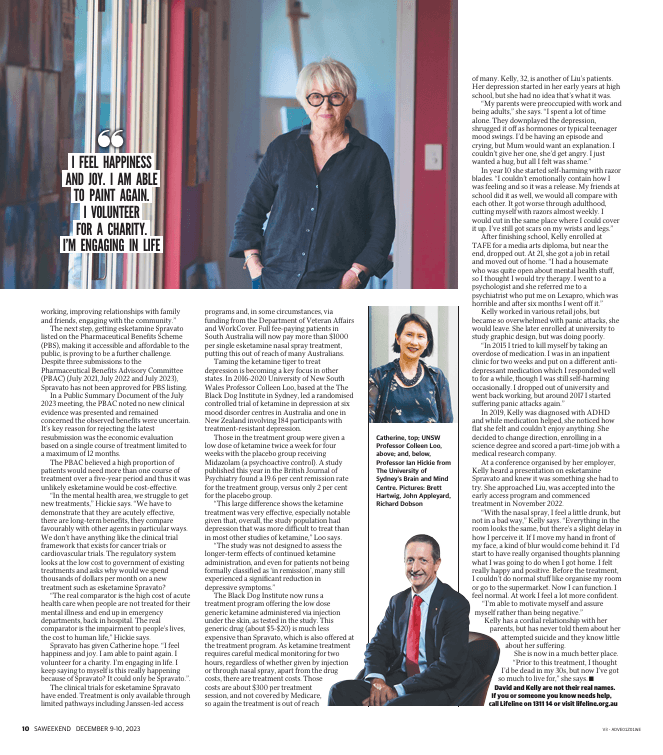
Liu agrees that the esketamine nasal spray is working. “My patients are no longer suicidal.
“They’re functioning again. They’re back working, improving relationships with family and friends, engaging with the community.” The next step, getting esketamine Spravato listed on the Pharmaceutical Benefits Scheme (PBS), making it accessible and affordable to the public, is proving to be a further challenge. Despite three submissions to the Pharmaceutical Benefits Advisory Committee (PBAC) (July 2021, July 2022 and July 2023), Spravato has not been approved for PBS listing.
In a Public Summary Document of the July 2023 meeting, the PBAC noted no new clinical evidence was presented and remained concerned the observed benefits were uncertain. It’s key reason for rejecting the latest resubmission was the economic evaluation based on a single course of treatment limited to a maximum of 12 months.
The PBAC believed a high proportion of patients would need more than one course of treatment over a five-year period and thus it was unlikely esketamine would be cost-effective.
“In the mental health area, we struggle to get new treatments,” Hickie says. “We have to demonstrate that they are acutely effective, there are long-term benefits, they compare favourably with other agents in particular ways. We don’t have anything like the clinical trial framework that exists for cancer trials or cardiovascular trials. The regulatory system looks at the low cost to government of existing treatments and asks why would we spend thousands of dollars per month on a new treatment such as esketamine Spravato?
“The real comparator is the high cost of acute health care when people are not treated for their mental illness and end up in emergency departments, back in hospital. The real comparator is the impairment to people’s lives, the cost to human life,” Hickie says.
Spravato has given Catherine hope. “I feel happiness and joy. I am able to paint again. I volunteer for a charity. I’m engaging in life. I keep saying to myself is this really happening because of Spravato? It could only be Spravato.”.
The clinical trials for esketamine Spravato have ended. Treatment is only available through limited pathways including Janssen-led access
programs and, in some circumstances, via funding from the Department of Veteran Affairs and WorkCover. Full fee-paying patients in South Australia will now pay more than $1000 per single esketamine nasal spray treatment, putting this out of reach of many Australians. Taming the ketamine tiger to treat
depression is becoming a key focus in other states. In 2016-2020 University of New South Wales Professor Colleen Loo, based at the The Black Dog Institute in Sydney, led a randomised controlled trial of ketamine in depression at six mood disorder centres in Australia and one in New Zealand involving 184 participants with treatment-resistant depression.
Those in the treatment group were given a low dose of ketamine twice a week for four weeks with the placebo group receiving Midazolam (a psychoactive control). A study published this year in the British Journal of Psychiatry found a 19.6 per cent remission rate for the treatment group, versus only 2 per cent for the placebo group.
“This large difference shows the ketamine treatment was very effective, especially notable given that, overall, the study population had depression that was more difficult to treat than in most other studies of ketamine,” Loo says.
“The study was not designed to assess the longer-term effects of continued ketamine administration, and even for patients not being formally classified as ‘in remission’, many still experienced a significant reduction in depressive symptoms.”
The Black Dog Institute now runs a treatment program offering the low dose generic ketamine administered via injection under the skin, as tested in the study. This generic drug (about $5-$20) is much less expensive than Spravato, which is also offered at the treatment program. As ketamine treatment requires careful medical monitoring for two hours, regardless of whether given by injection or through nasal spray, apart from the drug costs, there are treatment costs. Those costs are about $300 per treatment session, and not covered by Medicare, so again the treatment is out of reach of many. Kelly, 32, is another of Liu’s patients. Her depression started in her early years at high school, but she had no idea that’s what it was.
“My parents were preoccupied with work and being adults,” she says. “I spent a lot of time alone. They downplayed the depression, shrugged it off as hormones or typical teenager mood swings. I’d be having an episode and crying, but Mum would want an explanation. I couldn’t give her one, she’d get angry. I just wanted a hug, but all I felt was shame.”
In year 10 she started self-harming with razor blades. “I couldn’t emotionally contain how I was feeling and so it was a release. My friends at school did it as well, we would all compare with each other. It got worse through adulthood, cutting myself with razors almost weekly. I would cut in the same place where I could cover it up. I’ve still got scars on my wrists and legs.”
After finishing school, Kelly enrolled at TAFE for a media arts diploma, but near the end, dropped out. At 21, she got a job in retail and moved out of home. “I had a housemate who was quite open about mental health stuff, so I thought I would try therapy. I went to a psychologist and she referred me to a psychiatrist who put me on Lexapro, which was horrible and after six months I went off it.”
Kelly worked in various retail jobs, but became so overwhelmed with panic attacks, she would leave. She later enrolled at university to study graphic design, but was doing poorly.
“In 2015 I tried to kill myself by taking an overdose of medication. I was in an inpatient clinic for two weeks and put on a different anti depressant medication which I responded well to for a while, though I was still self-harming occasionally. I dropped out of university and went back working, but around 2017 I started suffering panic attacks again.”
In 2019, Kelly was diagnosed with ADHD and while medication helped, she noticed how flat she felt and couldn’t enjoy anything. She decided to change direction, enrolling in a science degree and scored a part-time job with a medical research company.
At a conference organised by her employer, Kelly heard a presentation on esketamine Spravato and knew it was something she had to try. She approached Liu, was accepted into the early access program and commenced treatment in November 2022.
“With the nasal spray, I feel a little drunk, but not in a bad way,” Kelly says. “Everything in the room looks the same, but there’s a slight delay in how I perceive it. If I move my hand in front of my face, a kind of blur would come behind it. I’d start to have really organised thoughts planning what I was going to do when I got home. I felt really happy and positive. Before the treatment, I couldn’t do normal stuff like organise my room or go to the supermarket. Now I can function. I feel normal. At work I feel a lot more confident.
“I’m able to motivate myself and assure myself rather than being negative.”
Kelly has a cordial relationship with her parents, but has never told them about her attempted suicide and they know little about her suffering.
She is now in a much better place.
“Prior to this treatment, I thought I’d be dead in my 30s, but now I’ve got so much to live for,” she says.
David and Kelly are not their real names. If you or someone you know needs help, call Lifeline on 1311 14 or visit lifeline.org.au
10 SAWeekend December 9-10, 2023 V3 - ADVE01Z01WE




Copyright @ 2026 All rights reserved.